




📶 Mesh Wi-Fi vs Single Router — Which Do You Really Need?

2026 Guide — Compare coverage, performance, cost, and real-world value
Whether you’re setting up Wi-Fi in a small apartment, a large home, or a multi-story house, you’ve probably wondered:
👉 Do I need a mesh Wi-Fi system?
👉 Is a single router good enough?
👉 What’s worth the cost?
This blog covers both options in plain language — so you can choose what’s best for your space and your budget.
📌 Quick Summary
| Feature | Single Router | Mesh Wi-Fi |
|---|---|---|
| Coverage | Small-medium spaces | Medium-large spaces |
| Installation | Easy | Easy-medium |
| Cost | Low | Higher |
| Performance | Good | Excellent (no dead zones) |
| Scalability | Limited | Easy expansion |
| Best for | Small flats / rooms | Larger homes / multi-floor |
🏠 1. What Is a Single Router?
A single router is the traditional way most homes get Wi-Fi — one box broadcasts Wi-Fi to your whole place.
✔️ Pros
✔ Cost-effective
✔ Easy plug-and-play setup
✔ Good performance within its range
✔ Many models with advanced Wi-Fi (Wi-Fi 6/6E/7)
❌ Cons
❌ Weak signal far from the router
❌ Dead zones in large or block-walled homes
❌ All devices compete for the same signal source
👉 Best for: Apartments, small homes, single-floor spaces where coverage isn’t a challenge.
🕸️ 2. What Is Mesh Wi-Fi?
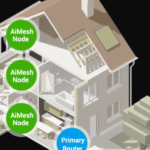
A mesh Wi-Fi system uses multiple nodes (router + satellites) that work together to blanket your home with Wi-Fi — all under one network name.
✔️ Pros
✔ Eliminates dead zones
✔ Seamless connectivity (same Wi-Fi name everywhere)
✔ Easy expansion (add more nodes)
✔ Better coverage across floors / walls
❌ Cons
❌ Higher cost upfront
❌ Slightly more complex setup
❌ You pay more even if you don’t need all that coverage
👉 Best for: Large homes, multi-floor houses, thick-wall spaces, or anyone tired of weak Wi-Fi spots.
📶 3. Coverage & Performance
🏡 Single Router Coverage
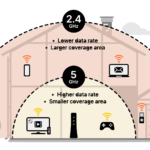
A good router can cover one medium room or standard apartment reliably — but as distance increases or walls intervene, signal strength drops.
Good use cases
✔ 1–2 bedroom apartment
✔ Small flat
✔ Single floor
🌐 Mesh Wi-Fi Coverage
Mesh systems let you strategically place nodes so coverage spreads evenly — even in distant rooms, basements, or upstairs areas.
Strong advantages:
✔ Nearly no dead zones
✔ Consistent speeds everywhere
✔ Devices switch between nodes seamlessly
Great for:
🏠 Large spaces
📶 Multi-story homes
🧱 Thick walls or obstacles
💡 4. Ease of Setup
📍 Single Router
- Plug in
- Connect to modem
- Follow app/QR setup
Done in minutes
📍 Mesh System
- Connect primary node to modem
- Place satellites where signal weakens
- Use app to configure coverage maps
Still easy with most modern systems, but involves more steps.
🧠 5. Performance & Congestion
Single Router
✔ Strong signal near the router
❌ Weaker at distance
❌ All devices use same radio
Mesh System
✔ Multiple nodes share load
✔ Better throughput in far rooms
✔ Less congestion overall
👉 If many people/devices use Wi-Fi at once, mesh often performs better.
💰 6. Cost Comparison
| Setup | Approx Cost (INR) |
|---|---|
| Single Router | ₹2,000 – ₹15,000+ |
| Mesh Wi-Fi (2–3 nodes) | ₹8,000 – ₹40,000+ |
Single routers are cheaper — but if weak coverage forces you to add repeaters later, a mesh system can be more cost-effective long term.
📊 7. When Each One Makes Sense
✅ Choose a Single Router if:
✔ Your home is small
✔ You don’t have many dead spots
✔ Cost is a priority
✔ You don’t need advanced coverage features
Best pick: Budget-friendly Wi-Fi 6/6E router
✅ Choose Mesh Wi-Fi if:
✔ Your home is large or multi-story
✔ You have persistent dead zones
✔ You stream, game, or work far from the router
✔ You want future-proof expandability
Best pick: Wi-Fi 6E / Wi-Fi 7 mesh systems
📌 Tips to Choose Better
🧠 Evaluate space first:
Measure from your router to farthest room. If weak signals already appear, mesh helps a lot.
📍 Check walls & obstacles:
Brick, concrete, and metal blocks weaken signals — mesh helps fill gaps.
📊 Think about users:
More users + heavy use (streaming, gaming, video calls) benefits from mesh.
🏁 Our Verdict
➡ Small spaces / apartments: Single Router — cost-effective & simple
➡ Large homes / dead zone issues: Mesh Wi-Fi — seamless wireless everywhere
➡ Heavy use (games, 4K streams): Mesh Wi-Fi — better real-world speeds
➡ Budget-tight: Single Router with Wi-Fi 6 / Wi-Fi 6E
🚀 Final Takeaway
You don’t need mesh Wi-Fi just because it exists — but if your current Wi-Fi struggles to reach every room with good speed, mesh Wi-Fi can be worth it.
📌 If your space is small, a good single router is still a great choice.
📌 If your home has coverage gaps — mesh is usually worth the investment.